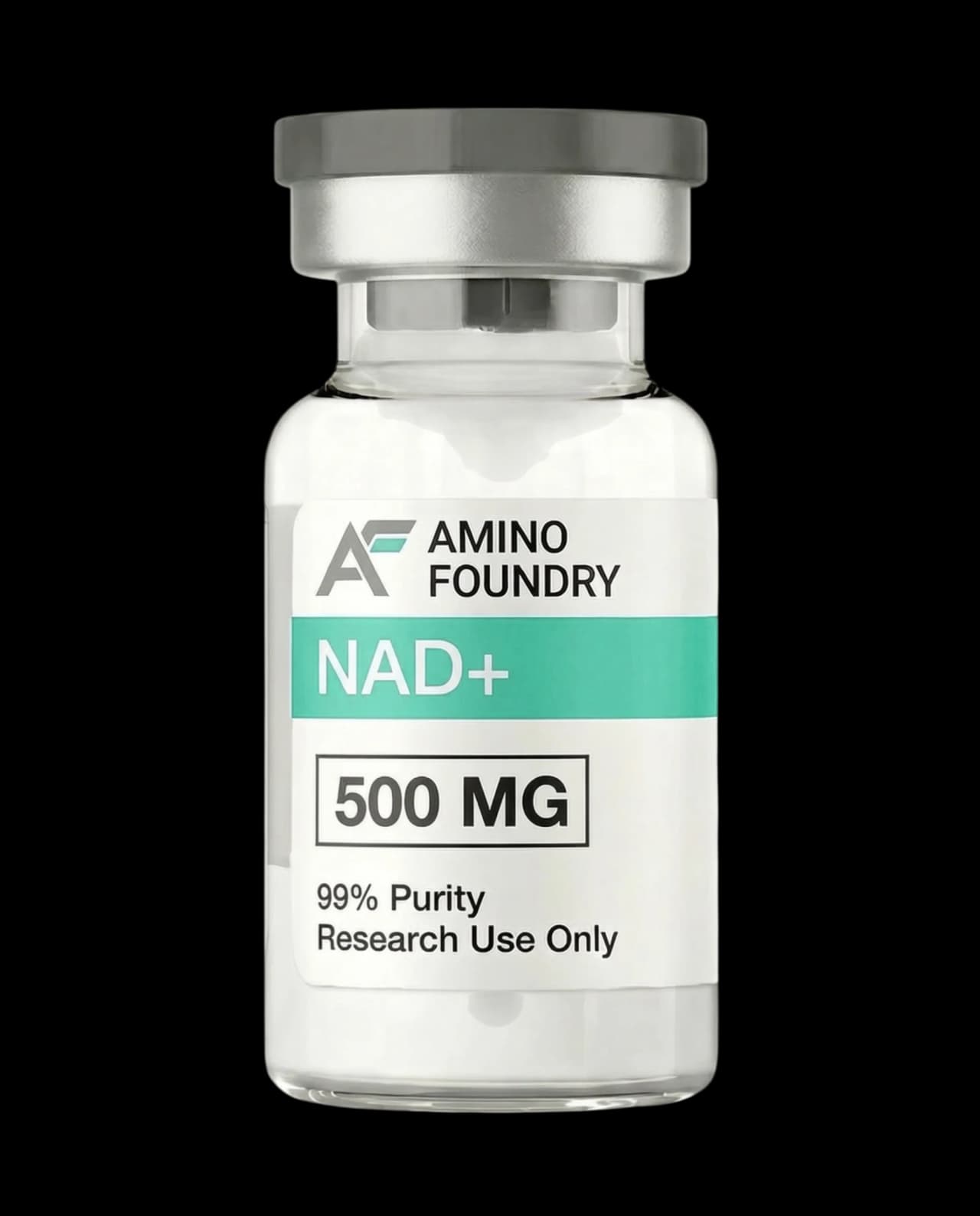
NAD+ is nicotinamide adenine dinucleotide, a small-molecule cofactor found in essentially all living cells. It is not a peptide. It is a dinucleotide, built from two nucleotides joined through their phosphate groups. In the Amino Foundry catalog it carries the molecular formula C21H27N7O14P2, a molecular weight of 663.43 g/mol (anhydrous free acid), and CAS number 53-84-9. It is supplied as a lyophilized material for laboratory research and is intended solely for research purposes.
NAD+ is studied in biochemistry for two broad roles: as a redox cofactor that shuttles electrons in metabolic reactions, and as a substrate that is consumed by several families of enzymes. These two roles are chemically distinct, and keeping them separate is the starting point for reading the NAD+ literature accurately.
What is the molecular structure of NAD+?
The molecule consists of an adenosine monophosphate unit and a nicotinamide mononucleotide unit connected by a pyrophosphate bridge. One half carries the adenine base attached to a ribose sugar. The other half carries the nicotinamide ring attached to a second ribose. The two ribose units are linked through the two phosphate groups, which gives the molecule its dinucleotide character and its two phosphorus atoms, consistent with the P2 in the formula.
The nicotinamide ring is the chemically active region for redox work. In the oxidized form, written NAD+, the ring carries a positive charge on the nitrogen. In the reduced form, NADH, the ring has accepted a hydride, which changes its electronic structure and its absorbance properties. That difference in absorbance near 340 nm is the basis of many classical spectrophotometric assays that track NAD+/NADH conversion in vitro.
The molecule is highly polar and water soluble, carries multiple negative charges at neutral pH from its phosphate groups, and does not behave like a hydrophobic small molecule or a typical peptide. That has consequences for analytical method selection, covered below.
How does NAD+ function as a redox cofactor?
In metabolic biochemistry, NAD+ accepts a hydride from a substrate in dehydrogenase reactions, becoming NADH. The NADH formed can then donate electrons elsewhere, notably to the mitochondrial electron transport chain. The NAD+/NADH pair is therefore described as a central redox couple in cellular metabolism, and the ratio between the two forms is a commonly measured parameter in cell-based research.
Glycolysis, the tricarboxylic acid cycle and fatty acid oxidation all contain NAD+-dependent dehydrogenase steps. A related cofactor, NADP+, carries an extra phosphate group and is used predominantly in biosynthetic reactions, so the two are treated as functionally distinct pools in published work. Researchers designing experiments around redox state need to specify which pool and which compartment they are measuring, since NAD+ and NADH concentrations differ between the cytosol and mitochondria.
Which enzyme families consume NAD+?
Apart from its redox role, NAD+ is a substrate that is cleaved by several enzyme families. In these reactions the nicotinamide group is released and the remaining adenosine diphosphate ribose portion is transferred or processed. Three families appear most often in the literature.
Sirtuins are NAD+-dependent deacylases. They use NAD+ as a co-substrate when removing acyl groups from protein lysine residues, and their activity in vitro depends directly on NAD+ availability. Poly(ADP-ribose) polymerases, or PARPs, use NAD+ to build ADP-ribose chains on target proteins and are studied in the context of DNA damage signaling. CD38 and related NAD+ glycohydrolases hydrolyze NAD+ and generate signaling metabolites such as cyclic ADP-ribose.
Because all of these enzymes draw on the same substrate pool, the research literature often discusses competition among them. This is a framing for in vitro and cell-model work and describes enzymology, not outcomes.
How is NAD+ made and recycled in cells?
Published biochemistry describes several routes for maintaining the cellular NAD+ pool. The de novo pathway builds the molecule from the amino acid tryptophan. Salvage pathways recycle the nicotinamide released by NAD+-consuming enzymes, converting it back through intermediates such as nicotinamide mononucleotide. Related precursors, including nicotinamide riboside and nicotinic acid, enter through additional routes.
For a laboratory researcher the practical meaning is that NAD+ levels in a cell culture experiment reflect a balance of synthesis, recycling and consumption. An experiment that measures NAD+ at one time point is observing a snapshot of that balance. Careful designs therefore record time course, cell type and culture conditions alongside any measurement.
How does NAD+ differ from the peptides in the catalog?
Most compounds in the Amino Foundry catalog are peptides, and many of them, such as BPC-157 and MOTS-c, are studied through receptor binding or signaling pathways. NAD+ sits in a different category. It is a cofactor and an enzyme substrate, so its research framework is enzymology and metabolism, not receptor pharmacology.
Property
Typical research peptide
NAD+
Molecular class
Amino acid chain
Dinucleotide
Primary research framing
Receptor binding, signaling
Redox cofactor, enzyme substrate
Key structural feature
Sequence and modifications
Nicotinamide ring, pyrophosphate bridge
Typical analytical considerations
Reversed-phase HPLC, mass spectrometry
Ion-pairing or HILIC methods, UV absorbance
This distinction matters when planning assays. A method developed for a peptide will not necessarily transfer to a highly polar, multiply charged dinucleotide.
What are the stability and analytical considerations?
NAD+ is sensitive to its environment. In solution it is susceptible to hydrolysis, and the glycosidic bond that joins nicotinamide to ribose is the most labile part of the molecule. Alkaline conditions degrade it, and prolonged exposure to heat and moisture accelerates breakdown. Amino Foundry supplies the material as a lyophilized powder stored at −20°C, which is the usual approach for limiting degradation of a hydrolysis-prone compound in the solid state.
On the analytical side, the identity facts above give a researcher concrete targets: a molecular weight of 663.43 g/mol for the anhydrous free acid and the formula C21H27N7O14P2. Because the molecule is polar, retention on standard reversed-phase columns can be poor, and published methods commonly use ion-pairing agents or hydrophilic interaction chromatography. Mass spectrometry confirms identity, while UV absorbance near 260 nm reflects the adenine chromophore. Researchers should note that the hydration state and counter-ions affect the apparent molecular weight, which is why the catalog specifies the anhydrous free acid.
This article does not provide preparation instructions. Handling protocols are determined by the researcher according to experimental requirements and applicable regulations.
What should researchers record when designing NAD+ experiments?
Because NAD+ participates in so many reactions, an experimental record that omits context is hard to interpret later. Useful fields include the model system and cell type, the compartment being measured, the assay readout and its detection limits, and the time points sampled. It is also worth recording which NAD+-consuming enzymes are active in the system, since sirtuins, PARPs and CD38 all draw on the same substrate pool and can shift measured levels independently of synthesis.
Controls deserve the same care. Reporting the NAD+/NADH ratio alongside absolute NAD+ concentration, and noting how samples were quenched and extracted, reduces the chance that handling artifacts are mistaken for biology. Published work on NAD+ metabolism often attributes inconsistent results to differences in extraction chemistry, which is a reminder that the measurement method is part of the finding.
How does Amino Foundry source NAD+?
Amino Foundry supplies NAD+ as a research-grade compound with a purity specification of 99% and batch-specific analytical documentation. For guidance on interpreting that documentation, see our article on how to read a Certificate of Analysis. Researchers can review specifications, available sizes and pricing on the product page for NAD+, or browse the full catalog of research compounds at all compounds. All material is intended for laboratory research use only.
This compound is a research chemical intended for laboratory and scientific research purposes only. It is not a drug, supplement, or food, and is not intended to diagnose, treat, cure, or prevent any disease. Amino Foundry does not sell products intended for human consumption. Researchers are responsible for compliance with all applicable local, state, and federal regulations.
Stay in the loop
New compounds, research updates & exclusive subscriber deals.