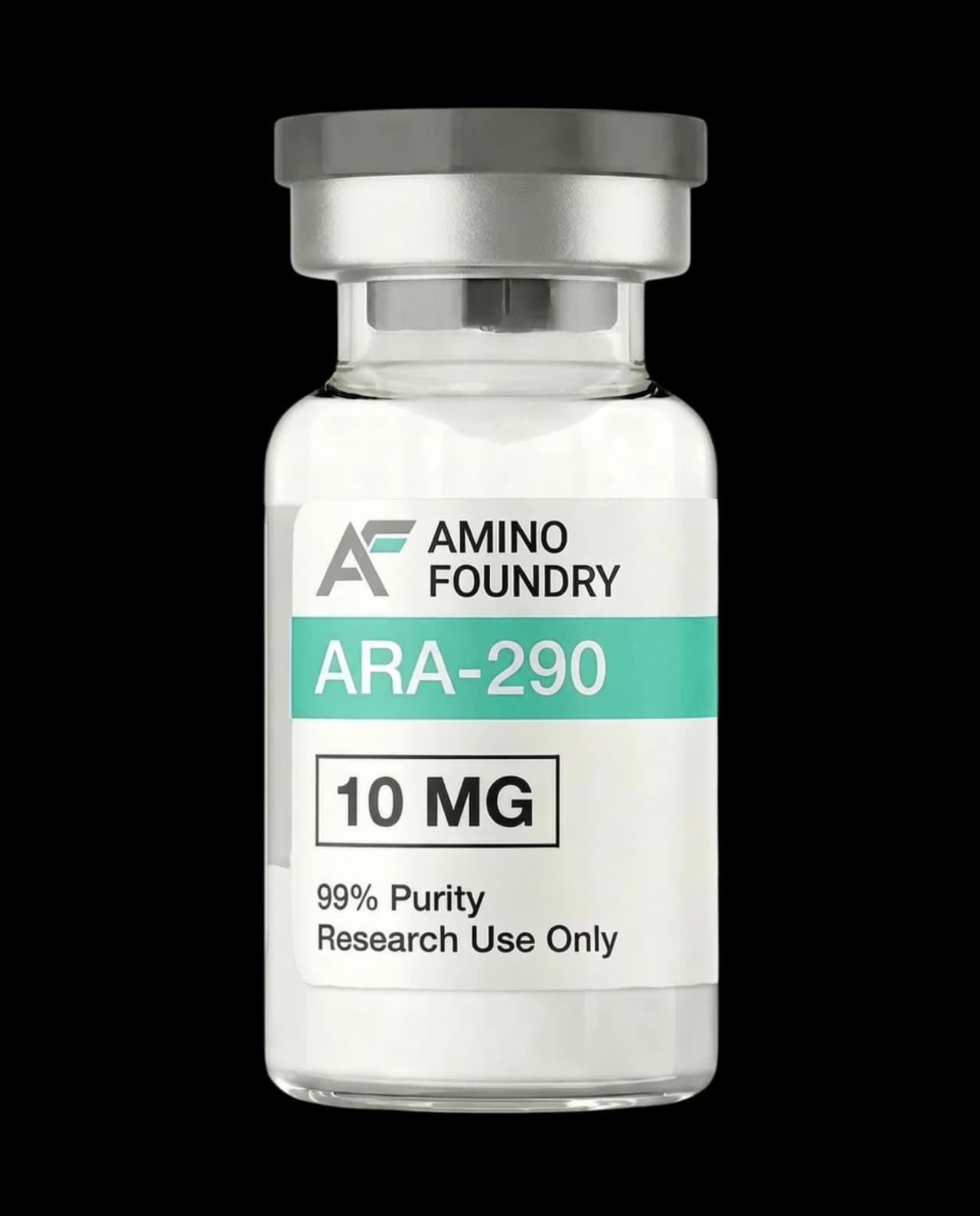
ARA-290 is a synthetic peptide classified as a helix B surface peptide, or HBSP. It is derived from the helix B region of erythropoietin, a signaling protein best known in biochemistry for its role in red blood cell development. In the Amino Foundry catalog it is listed under the category Healing, with formula C51H84N16O21, molecular weight 1257.3 g/mol and CAS 1208243-50-8. It is a research compound for laboratory investigation only.
What is the molecular structure of ARA-290?
The catalog formula C51H84N16O21 describes a peptide of 51 carbon, 84 hydrogen, 16 nitrogen and 21 oxygen atoms. The sixteen nitrogens and twenty-one oxygens reflect a peptide backbone with several polar and charged side chains, and the absence of sulfur indicates that the sequence contains no cysteine or methionine. That composition is a structural observation drawn from the formula alone.
The catalog lists a molecular weight of 1257.3 g/mol, which places ARA-290 well below the size of whole protein hormones and in the range of other short peptides studied in the lab. A second internal catalog source lists a slightly lower figure, 1256.4 g/mol, a reminder that reported weights vary with rounding, salt form and whether average or monoisotopic mass is quoted. For identity work, the measured mass of a lot is what counts.
How does ARA-290 relate to erythropoietin?
Erythropoietin is a large glycoprotein, and its three-dimensional fold places several alpha helices in a bundle. The helix B region is one of those segments. A helix B surface peptide is a short sequence designed to reproduce a stretch of that surface without carrying the rest of the protein, which is what makes ARA-290 structurally a fragment-derived design and not a full-length analog.
This design matters for research framing. Because the peptide is far smaller than the parent protein, questions about which receptor it engages cannot be answered by assuming it behaves like erythropoietin. They have to be answered by the published binding and signaling studies, which describe the peptide in the context of a different receptor assembly.
What receptor is ARA-290 associated with in the literature?
Published work associates ARA-290 with the innate repair receptor, often abbreviated IRR. The receptor is described as a heteromeric assembly formed from the erythropoietin receptor subunit together with the common beta receptor subunit, and it is contrasted with the homodimeric erythropoietin receptor linked to red blood cell production. The catalog's compound page lists the receptor targets as the innate repair receptor and the erythropoietin receptor heterodimer.
For a researcher, the key distinction is homodimer versus heterodimer. The same erythropoietin receptor subunit appears in both assemblies, so experiments that attempt to tell them apart depend on the cell type, the subunits expressed and the readout chosen. Statements about this receptor in published reports come from defined model systems and should be read with those systems in mind.
What does the research literature describe?
Published studies on ARA-290 describe it in cell and animal models and have examined signaling readouts connected to the innate repair receptor. This overview does not summarize outcome data, and no claim is made here about effects in people. A reader approaching the literature should sort each statement into one of three bins: direct receptor interaction in a defined system, pathway activity in cells or animals, and hypothesis.
A second consideration is that much of the experimental interest in the peptide comes from its being a small, defined molecule. A short sequence is easier to synthesize, characterize and compare across labs than a glycosylated protein, which makes analytical comparison more tractable. That is a practical property of the molecule, not a statement about its biological effect.
How does ARA-290 compare with other catalog peptides?
Placing ARA-290 next to other catalog entries shows how different the structural profiles are. BPC-157 is listed with formula C62H98N16O22 and molecular weight 1419.56 g/mol, a pentadecapeptide with the same nitrogen count as ARA-290 but a larger overall mass. SS-31 is much smaller, listed at 639.80 g/mol with formula C32H49N9O5.
Size and composition alone do not predict mechanism, but they change which questions are reasonable. A researcher comparing these peptides would treat each as its own system, with a different receptor literature behind it. The comparison view on Amino Axiom is one place to line up two such compounds, and the Amino Foundry walkthrough of Compound Compare shows that reading method.
What naming and sourcing issues come up with ARA-290?
Short peptides frequently circulate under more than one label, and helix B surface peptides are no exception. Entries can differ in capitalization, hyphenation or abbreviation, and a name alone is not a reliable identifier. The CAS number 1208243-50-8 and the molecular formula are the anchors that make two listings comparable, and both should be matched before any two sources are treated as describing the same molecule.
Counter-ion form is the other recurring source of confusion. A peptide supplied as an acetate or trifluoroacetate salt has a higher gross mass than the free peptide, so a catalog weight and a measured weight can legitimately differ. Knowing which form each source reports is part of reading analytical data correctly.
How should an ARA-290 study be designed around its chemistry?
Chemistry shapes design before biology does. A peptide of about 1257 g/mol with sixteen nitrogens is polar, and polar peptides behave differently from hydrophobic ones in chromatography, in solution and on surfaces. These properties affect how a sample is characterized, how recovery is measured and how stable a reference standard remains over time.
Storage conditions are listed in the catalog as -20 °C for the lyophilized material, and protection from direct light is listed in the compound content. Beyond that, any protocol decision belongs to the investigator's own validated methods and institutional requirements. This article does not describe handling steps, and nothing here should be read as guidance for use.
How is the identity of ARA-290 verified?
A catalog entry describes a compound in general. Verifying a specific lot is an analytical task, usually done with reversed-phase HPLC to assess purity and mass spectrometry to confirm that the measured mass matches the expected value for C51H84N16O21. The Amino Foundry catalog lists purity at 99 percent or greater by HPLC and storage at -20 °C as a lyophilized solid.
Those are catalog specifications, and the document that confirms them for a given lot is its Certificate of Analysis. The Amino Foundry guides to reading a Certificate of Analysis and to peptide purity explain what each reported field means and what a mismatch looks like.
What open questions remain in ARA-290 research?
Several questions are still debated in the receptor literature. One is how reliably the heteromeric receptor can be distinguished from the homodimeric one in a given cell type, since both involve the same erythropoietin receptor subunit. Another is how far findings from cell lines and animal models generalize across species, which is a standing limitation for any preclinical peptide.
A third concerns assay design. Binding, signaling and downstream readouts each answer a different question, and a result from one does not stand in for the others. Investigators reading the literature benefit from tabulating, for every claim, the assay type, the model and the readout, then comparing across papers on those terms rather than on headline conclusions. That habit also makes it clear which parts of the picture rest on a single group's work and which have been reproduced independently.
Because the compound is a small, defined peptide, replication is practical in principle: the sequence, formula and mass are all specified, so independent groups can work from the same reference material. Analytical agreement between labs on identity is the foundation that makes mechanistic comparison across studies meaningful.
What should researchers keep in mind?
ARA-290 is a short, well-defined peptide whose literature centers on the innate repair receptor, and most of the mechanistic detail sits in preclinical systems. The honest summary is that identity facts are easy to pin down and mechanism claims need to be read against their model systems. Any new project should begin with the primary literature, with this overview serving only as orientation.
This article is for informational and laboratory research purposes only. The compounds discussed are research chemicals, not drugs, supplements, or food, and are not intended for human consumption. Amino Foundry does not sell products intended for human use. Researchers are responsible for compliance with all applicable local, state, and federal regulations.
Reference
Common questions
ARA-290 is a synthetic helix B surface peptide, a short sequence derived from the helix B region of erythropoietin. It is investigated in laboratory research as a ligand associated with the innate repair receptor. It is a research compound and is not intended for human use.
The Amino Foundry catalog lists ARA-290 with the molecular formula C51H84N16O21, a molecular weight of 1257.3 g/mol, and CAS 1208243-50-8. Values can differ slightly between sources because of rounding or counter-ion form, so a lot-specific Certificate of Analysis should be checked.
ARA-290 is modeled on a short stretch of the erythropoietin protein, the helix B region, rather than the whole molecule. Research describes this fragment in the context of the innate repair receptor, a heteromer distinct from the classical homodimeric erythropoietin receptor associated with red blood cell biology.
Identity is typically confirmed with HPLC for purity and mass spectrometry for molecular weight, compared against the expected value for the formula. The Certificate of Analysis for a specific lot is the relevant record, since a catalog entry describes the compound in general rather than a batch.
Stay in the loop
New compounds, research updates & exclusive subscriber deals.