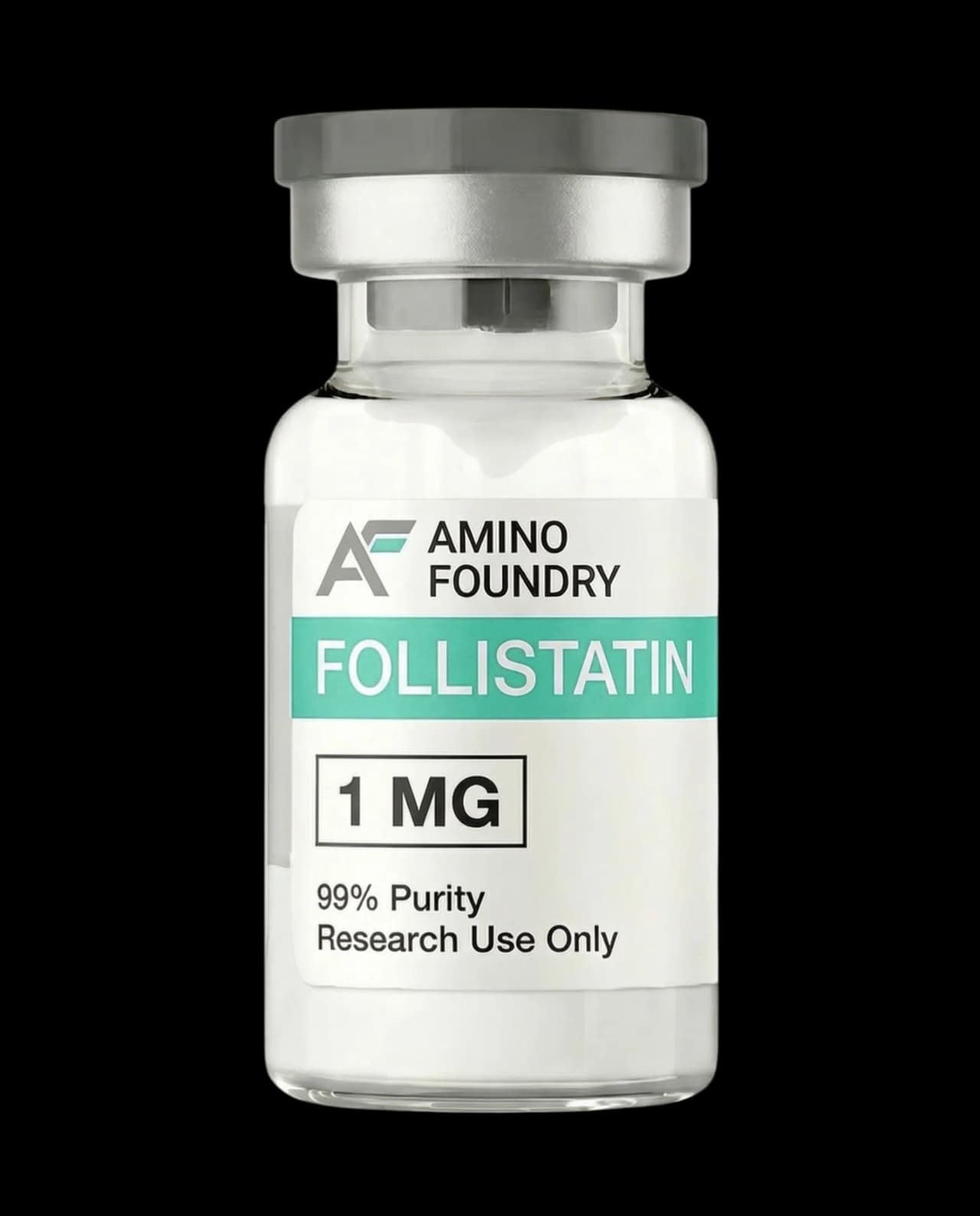
What is Follistatin?
Follistatin is a secreted glycoprotein studied extensively in research for its role as an endogenous antagonist of multiple members of the transforming growth factor-beta (TGF-β) superfamily. It was first characterized in studies of pituitary cell biology, where it was identified as a factor capable of suppressing follicle-stimulating hormone secretion — a property reflected in the compound name. Subsequent structural and functional research revealed that this FSH-suppressive activity was a downstream consequence of a broader and mechanistically more significant function: high-affinity, non-competitive binding to activin ligands that prevents them from engaging their cell-surface receptors.
Follistatin is encoded by the FST gene and is expressed across a wide range of tissue types, with documented expression in skeletal muscle, ovary, testis, pituitary, skin, kidney, and various developing tissues. The protein circulates in multiple isoforms of differing length, which arise from alternative splicing and proteolytic processing of the primary translation product. Each isoform retains the core follistatin domain architecture responsible for ligand binding but differs in its C-terminal extension, a structural variable that substantially affects both the duration of ligand sequestration and the affinity for extracellular matrix proteoglycans.
For research purposes, Follistatin is studied as a tool for modulating TGF-β superfamily signaling — particularly activin A, activin B, myostatin (GDF-8), and GDF-11 — in cell-culture and preclinical models. It is supplied as a recombinant protein intended solely for laboratory research and is not approved for any therapeutic application.
What is the molecular structure of Follistatin?
Follistatin is a glycoprotein, not a short linear synthetic peptide, and its structural characterization reflects that complexity. The primary translation product contains a signal peptide that is cleaved during secretion, yielding a mature protein whose mass varies across isoforms and glycosylation states. The two most extensively studied isoforms are the 288-amino-acid form (FST288) and the 315-amino-acid form (FST315), named for the number of residues in each mature protein. A shorter 303-residue form also exists but is less characterized.
The defining structural element of Follistatin is its follistatin domain (FSD) — a compact, cysteine-rich module stabilized by three intramolecular disulfide bonds. Each Follistatin monomer contains three tandem copies of this module (FSD1, FSD2, FSD3) preceded by an N-terminal domain (ND) that makes primary contact with ligand. Published crystallographic analyses have resolved Follistatin in complex with activin A and myostatin, revealing that the protein wraps around the ligand dimer and physically occludes both type I and type II receptor-binding sites simultaneously. This structural mode of antagonism is sometimes described as a "molecular cage" geometry — the ligand is enclosed rather than simply blocked at a single epitope.
The N-linked glycosylation sites on Follistatin are functionally relevant: glycosylation affects the half-life, isoelectric point, and heparan sulfate proteoglycan-binding affinity of the protein. Research characterizing the unglycosylated recombinant form versus glycosylated preparations has documented differences in binding kinetics and biological activity in cell-culture assays, an important variable when interpreting in vitro data.
How does Follistatin antagonize activin signaling?
Activins are homodimeric or heterodimeric ligands of the TGF-β superfamily, most commonly studied as activin A (comprising two βA subunits). They signal through a canonical receptor complex consisting of two type II receptor subunits (primarily ACVR2A or ACVR2B) that recruit and transphosphorylate two type I receptor subunits (primarily ALK4). The assembled complex phosphorylates SMAD2 and SMAD3, which form heterotrimers with SMAD4 and translocate to the nucleus to regulate transcription.
Published structural studies demonstrate that Follistatin binds the activin A dimer with very high affinity — among the tightest protein-protein interactions documented for any TGF-β superfamily antagonist. The binding interface is extensive, involving contacts from the Follistatin N-terminal domain and all three follistatin domains with both subunits of the activin dimer. Because Follistatin occupies both receptor-binding surfaces of the activin dimer in a single binding event, the inhibition is stoichiometric: one Follistatin molecule neutralizes one activin dimer without requiring receptor competition.
In cell-culture models, Follistatin treatment is used to suppress SMAD2/3 phosphorylation downstream of activin stimulation, providing a mechanistic tool for isolating the contribution of activin signaling to observed phenotypes. Research in gonadal cell cultures, embryonic stem cell differentiation systems, and muscle satellite cell models has used Follistatin as a benchmark antagonist to parse the role of activin A versus other SMAD2/3-activating ligands in the same experimental context.
How does Follistatin interact with myostatin?
Myostatin (GDF-8) is a TGF-β superfamily member that functions as a negative regulator of skeletal muscle mass. It signals through a receptor complex similar to activin A, engaging ACVR2B as the primary type II receptor and ALK4 or ALK5 as type I receptors to drive SMAD2/3 phosphorylation and downstream transcriptional changes that suppress muscle protein synthesis and satellite cell activation.
Follistatin binds myostatin with high affinity through the same structural mechanism used for activin binding — the follistatin domain array encircles the myostatin dimer, occluding its receptor-binding epitopes. Published co-crystal structures and surface plasmon resonance analyses confirm that the Follistatin-myostatin interaction follows similar thermodynamic principles to the Follistatin-activin interaction, though the precise binding affinities differ between ligands.
In skeletal muscle research models, Follistatin is studied as a myostatin neutralizing agent and is frequently used to define the myostatin-dependent component of muscle mass regulation. Cell-culture studies in C2C12 myoblasts and primary satellite cell preparations have applied Follistatin to investigate how myostatin signaling suppresses myoblast differentiation and how its removal affects the SMAD and non-SMAD downstream cascades. Because Follistatin inhibits both activin A and myostatin — ligands that both activate ACVR2B-dependent signaling — its effects in these systems represent combined blockade of multiple related inputs, which research designs must account for when attributing findings to a single ligand.
The two primary isoforms, FST288 and FST315, differ in the length of their C-terminal extensions beyond the third follistatin domain. This structural difference has functional consequences that are relevant to research interpretation.
FST288 contains a heparan sulfate proteoglycan-binding sequence in its extended C-terminus that tethers the protein to cell surfaces and extracellular matrix. Published cell-biology studies characterize FST288 as the locally acting isoform — it binds to pericellular proteoglycans and sequesters ligand in the immediate tissue microenvironment, producing effects that are spatially restricted. FST315 lacks this proteoglycan-binding region due to the proteolytic processing at the C-terminus, resulting in a form that is less cell-associated and exhibits broader distribution in solution and in vivo models.
In research applications, the isoform selected affects the spatial scale of ligand antagonism observed in experimental systems. Studies examining autocrine or juxtacrine activin signaling in a monolayer culture may produce different results with FST288 versus FST315 simply because of their differential matrix binding. Published comparative analyses have characterized the distinct biological profiles of each isoform in cell-culture and tissue explant settings, establishing isoform identity as a key experimental variable that should be reported in methods.
How does Follistatin interact with other TGF-β superfamily members?
Beyond activin A, activin B, and myostatin, Follistatin has documented binding activity toward several additional TGF-β ligands. Published binding studies identify GDF-11 as another Follistatin target with substantial affinity; GDF-11 signals through the same ACVR2B pathway and is studied in the context of tissue homeostasis and aging biology in preclinical models.
BMP-2, BMP-4, BMP-7, and related bone morphogenetic proteins also bind Follistatin, though with lower affinity than the activin ligands. The structural basis for this differential affinity has been examined through mutagenesis studies and structural comparisons: certain surface residues in the Follistatin N-terminal domain that are critical for high-affinity activin binding are less complementary to the BMP binding interface, reducing the thermodynamic favorability of BMP interactions.
This selectivity profile means that in research settings where multiple TGF-β superfamily members are active, Follistatin preferentially sequesters activin and myostatin ligands over BMP ligands. Research designs intended to isolate BMP pathway function are therefore better served by BMP-specific antagonists (such as noggin or chordin) rather than Follistatin, whose dual activin/myostatin blockade would confound the interpretation. This mechanistic specificity is one reason Follistatin is studied as a selective tool for activin-axis research rather than as a generic TGF-β superfamily inhibitor.
What research models use Follistatin?
Follistatin is applied in a range of cell-culture and preclinical research models where activin or myostatin pathway dissection is the experimental goal. Skeletal muscle satellite cell cultures use Follistatin to investigate myostatin-dependent regulation of myoblast proliferation and differentiation, establishing a signaling-blocked baseline against which other pathway perturbations can be measured. Alongside BPC-157, Follistatin is referenced in tissue-repair research literature in the context of growth factor environments that influence cell behavior, though the two act through distinct mechanisms and are not mechanistically interchangeable.
Reproductive biology research applies Follistatin in granulosa cell and gonadotroph cultures to study activin's role in FSH regulation and gonadal function. Embryonic stem cell and induced pluripotent stem cell differentiation protocols use Follistatin to suppress activin/Nodal signaling during specific developmental windows, as activin-SMAD2/3 signaling is a key instructive input in early cell-fate decisions. Cardiac and fibrotic research models use Follistatin to probe activin A's role in cardiac hypertrophy and tissue fibrosis pathways.
In each application, Follistatin functions as a molecular tool — a high-affinity decoy that removes specific ligands from the signaling environment — rather than as a pathway activator. This passive, ligand-sequestration mode of action simplifies interpretation in many experimental designs: adding Follistatin is functionally equivalent to genetically removing its target ligands, without requiring genetic manipulation of the cell line.
What analytical considerations apply to Follistatin research?
Researchers working with recombinant Follistatin should evaluate several source-dependent variables that affect data reproducibility. Glycosylation state is the most significant: Follistatin produced in mammalian expression systems (HEK293, CHO) carries N-linked glycans, while E. coli-derived recombinant protein does not. Glycosylated preparations more closely replicate the native protein's properties but are costlier to produce, and the glycan composition may vary across production lots. Published binding assays have documented that glycosylation affects the binding kinetics of Follistatin-ligand interactions, which should be considered when comparing results across studies using different production platforms.
Isoform identity must be explicitly verified. A recombinant preparation labeled "Follistatin" without isoform specification may correspond to FST288, FST315, or a non-physiological truncation optimized for recombinant production yield. Published studies that compare isoform-specific effects cannot be reproduced with an unspecified preparation.
Bioactivity confirmation — typically via activin A stimulation and SMAD2/3 phosphorylation readout in an appropriate cell line, with Follistatin added at known molar ratios to the ligand — is standard practice for verifying lot activity before use in mechanistic experiments. A Certificate of Analysis confirming purity by SDS-PAGE or HPLC and identity by mass spectrometry is the minimum documentation standard for research-grade material.
Follistatin supplied by Amino Foundry is a recombinant research protein intended exclusively for in vitro laboratory research. It is not approved for human or animal use, is not a drug or supplement, and has not been evaluated by the FDA for any therapeutic application. Researchers are responsible for compliance with all applicable local, state, and federal regulations governing the use of research compounds. All content on this page is for research and informational purposes only.