What happened at the July 2026 FDA advisory committee meeting?
On July 23 and 24, 2026, the FDA's Pharmacy Compounding Advisory Committee met to review a slate of substances nominated for the Section 503A Bulk Drug Substances List, and BPC-157 was on the agenda. The committee voted to recommend adding BPC-157 to the list. That recommendation now sits with the FDA itself, which is not bound by its advisory committees: the agency makes the final call through its own rulemaking process, and no timeline for a final decision has been announced.
The vote was widely reported and quickly became the most-discussed regulatory event in the research peptide space this year — a notable reversal of direction for a compound the agency had previously moved to restrict. For anyone tracking the regulatory environment around research compounds, the mechanics of what this vote does and does not do are worth understanding precisely, because the gap between "an advisory committee recommended" and "the FDA decided" is where most of the misreporting lives.
What is the Section 503A Bulks List?
Section 503A of the Federal Food, Drug, and Cosmetic Act governs traditional pharmacy compounding — the practice of state-licensed pharmacies preparing medications for individual patients under a prescription. Compounders working under 503A may only use bulk drug substances that meet one of three criteria: the substance is the subject of an applicable USP or NF monograph, it is a component of an FDA-approved drug, or it appears on a list developed by the FDA of bulk drug substances that may be used in compounding — the "503A Bulks List."
BPC-157 meets neither of the first two criteria: it has no USP monograph and is not a component of any approved drug. That made the bulks list its only lawful route into pharmacy compounding. Substances nominated for the list are evaluated by the FDA with input from the Pharmacy Compounding Advisory Committee, which weighs the available characterization data, safety literature, and evidence of clinical interest before voting on a recommendation.
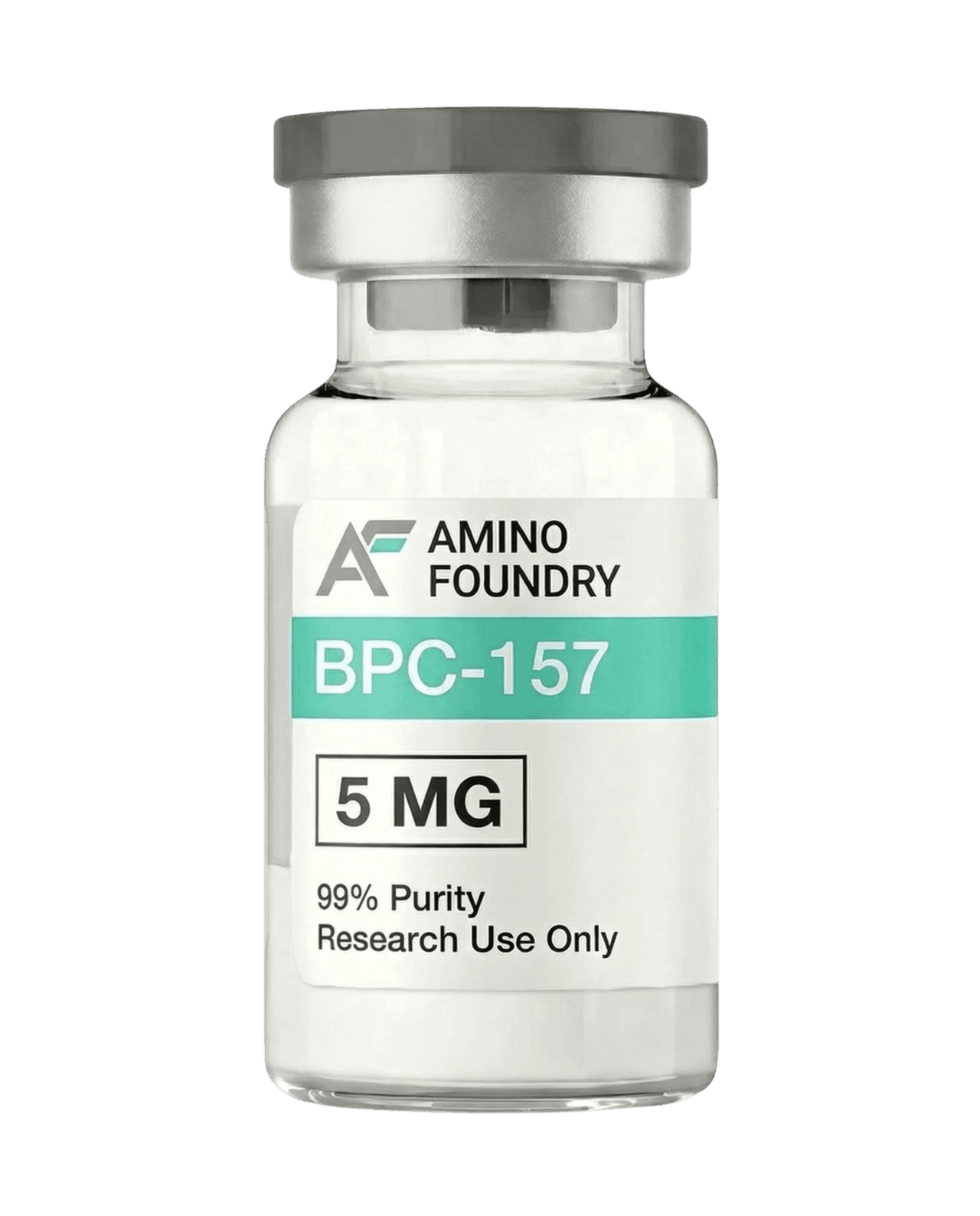
It bears repeating what this framework covers: prescription compounding by licensed pharmacies for identified patients. It has no bearing on the research-chemical category, where compounds are supplied strictly for laboratory research and are not for human use. Amino Foundry supplies BPC-157 for research purposes only, and nothing about a compounding-list decision changes that classification or that framing.
How did BPC-157 get here? The regulatory history
The July 2026 vote is the latest turn in a regulatory arc that has run for several years. In late 2023, the FDA placed BPC-157 in Category 2 of its interim bulks-list framework — the category for substances the agency considered to raise significant safety risks in compounding, citing limited human safety data and the absence of adequate characterization studies. Category 2 placement effectively signaled that compounding pharmacies should not use the substance, and several state boards followed the agency's lead. Throughout 2024 and 2025, clinics and compounders largely dropped BPC-157 from their formularies while demand-side interest in the compound continued to grow.
The nomination review that culminated in the July 2026 meeting reopened the question with a fuller record in front of the committee, including the expanded preclinical literature published in the intervening years. The committee's recommendation to add the substance to the list — rather than affirm its Category 2 status — is the part that made headlines. Reports from the meeting indicate committee members weighed the volume of preclinical evidence and the scale of existing public interest against the continuing thinness of controlled human data; the detailed meeting minutes and the agency's formal response remain the authoritative record, and the final regulatory status is unchanged until the FDA acts.
What is BPC-157, mechanistically?
Behind the regulatory story is one of the most heavily studied compounds in the research peptide field. BPC-157 is a pentadecapeptide — fifteen amino acids, sequence GEPPPGKPADDAGLV — derived from a protective protein identified in human gastric juice. It is classed as a "stable gastric pentadecapeptide" in the literature because, unlike most peptides of its size, it has been reported to remain stable in gastric-acid conditions, a property that shaped much of the early research program around it.
The 2025 literature and patent review by Józwiak and colleagues in Pharmaceuticals — the most comprehensive recent survey of the compound — catalogs the breadth of the preclinical record: studies in cell culture and animal models examining tissue repair processes, angiogenesis, and interactions with the nitric-oxide system, along with an unusually large patent footprint for a compound with no approved-drug status. The review also underlines the field's central caveat: the overwhelming majority of the evidence base is preclinical, generated in laboratory models rather than controlled human trials.
That caveat became its own scientific exchange in 2026, when Sikiric and colleagues — the Croatian group responsible for much of the original BPC-157 literature — published a comment on the review, arguing for a reading of the angiogenesis and nitric-oxide data in which the peptide's studied role is the maintenance and recovery of protective vascular function rather than indiscriminate promotion of vessel growth. The review authors' published reply continued the exchange. For researchers, the back-and-forth is a useful map of where the mechanistic questions actually stand: the modulation of the nitric-oxide pathway, the conditions under which angiogenic markers shift in injury models, and how much of the reported multifunctionality reflects one upstream mechanism versus many independent ones.
What does the vote mean for the research compound landscape?
In the near term, nothing changes. An advisory committee recommendation has no legal effect, and until the FDA issues a final determination, BPC-157's compounding status remains what it was. Researchers sourcing the compound for laboratory work are unaffected in either direction: research-use supply does not run through the 503A framework, and BPC-157 remains available for research applications with the same documentation standards as before — verified identity and 99%+ purity by HPLC, with the batch Certificate of Analysis available for every lot.
The medium-term implications are more interesting to watch. If the FDA ultimately adds BPC-157 to the bulks list, licensed compounding pharmacies could lawfully prepare it under prescription — which would make BPC-157 the rare compound to cross from the research-chemical category into regulated pharmacy compounding while still lacking an approved-drug pathway. That would likely pull parts of the demand curve toward the prescription channel, invite USP monograph development, and raise documentation expectations across the board. If the agency instead declines to follow its committee, the 2023 status quo effectively holds and the compound remains research-only in every channel.
Either way, the episode says something about where the field is heading: regulatory bodies are now engaging substantively with peptides that built their entire profile in the preclinical literature and the research-supply channel. Fields under active regulatory review reward suppliers and researchers who keep their documentation rigorous — batch-level identity confirmation, quantified purity, and a clean separation between what published research has examined and what anyone is entitled to claim.
What should researchers take away from this?
Three things. First, precision about status: as of this writing, BPC-157 has been recommended — not added — to the 503A Bulks List, and the FDA's final decision is pending. Statements that the compound is "now FDA-approved" or "cleared for use" are wrong on both counts; an approved drug application is a different process entirely, and no such application exists for BPC-157.
Second, the science is still being argued in the right way — in the literature, through reviews, comments, and replies — and the open mechanistic questions around angiogenesis and nitric-oxide signaling are tractable research problems, which is precisely what makes the compound a continuing subject of laboratory study.
Third, the regulatory record is now part of the compound's story. Researchers who work with BPC-157 should follow the FDA's final determination when it comes, because it will shape the supply landscape, the documentation norms, and the public conversation around the compound regardless of which way it goes. BPC-157 from Amino Foundry is supplied as a lyophilized powder for laboratory research use only and is not intended for human use; all discussion of the compounding framework above describes regulatory process, not any endorsement of use.
Cited literature
References
Primary literature and public databases referenced above. Each link resolves on the publisher or database of record.